

Sugar Industry Wastewater Treatment
Sugar Industry Wastewater Treatment
Nanozyme bioculture support for sugar mill ETPs and seasonal organic-load variation
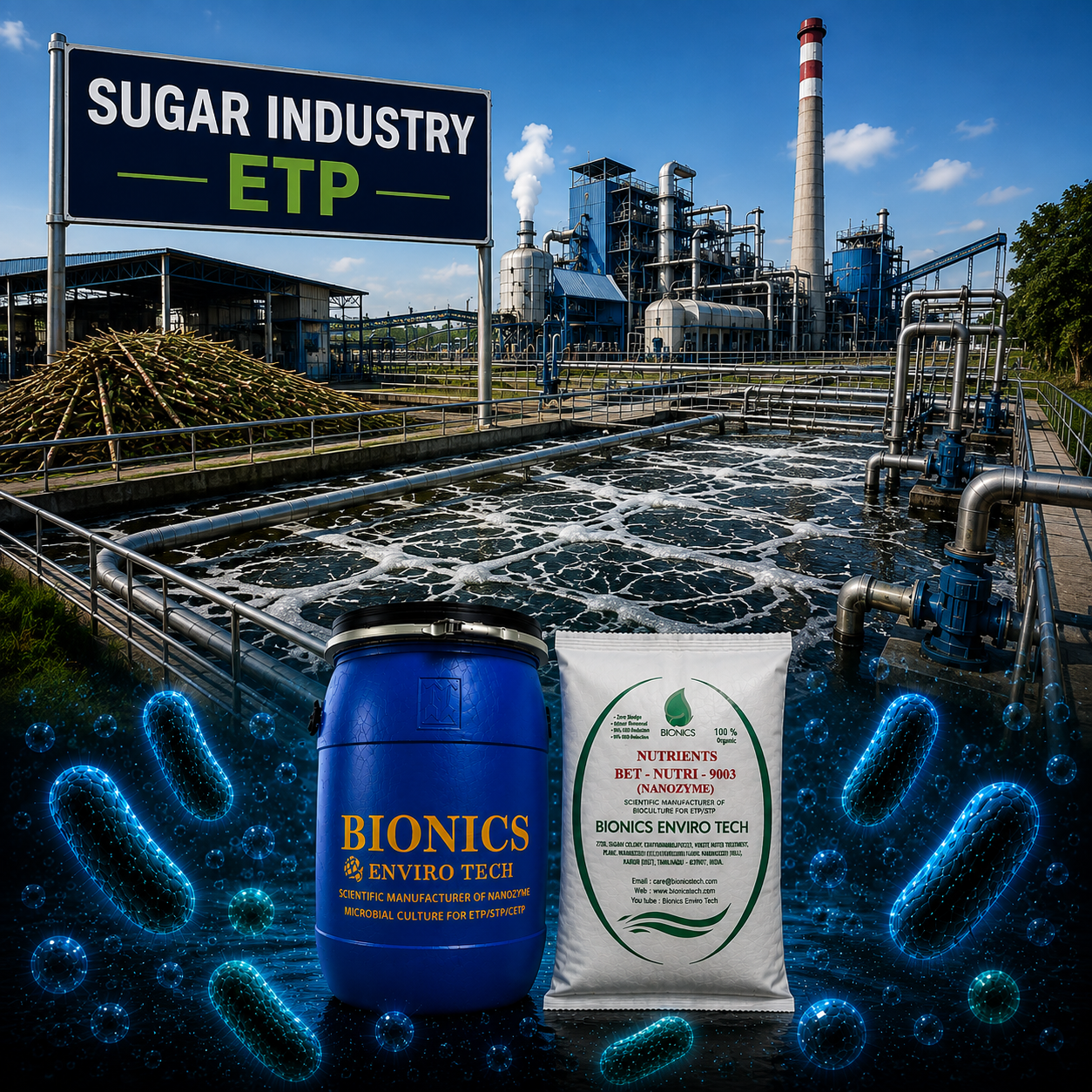
Bionics Nanozyme bioculture supports sugar industry wastewater treatment where cane washing, process losses, molasses-bearing streams and seasonal operation affect biological ETP performance.
Industry overview
Sugar Industry
Sugar mills generate wastewater from cane washing, mill-house cleaning, clarification, evaporation and crystallisation operations, equipment washing and cooling or condensate systems. Process losses can introduce juice, syrup and molasses into the ETP.
These biodegradable sugar-rich streams can create rapid COD and BOD loading, low dissolved oxygen, odour and biomass instability. Bagasse, press mud and filter cake should be recovered as process solids rather than allowed to burden wastewater treatment.
Bionics Nanozyme bioculture supports the assessed aerobic biological stage after screening, source control and equalisation. Selection and dosing depend on seasonal flow, organic loading, pH, nutrients, dissolved oxygen and biomass condition.
Wastewater Characteristics
Sugar Industry Wastewater Characteristics
Sugar Industry wastewater varies with raw materials, production schedules and cleaning operations. Assessment is required before biological application.
| Parameter | Typical Range |
|---|---|
| COD and BOD | High and variable from juice, syrup, molasses and wash-water losses |
| Sugars and Carbohydrates | Readily biodegradable and capable of rapid oxygen depletion |
| TSS | Soil, cane fibre and process solids from washing and handling |
| pH | Process and cleaning dependent |
| Nutrient Balance | Must be assessed for stable biological treatment |
| Colour | Molasses and process dependent; polishing may be required |
| Flow | Strong seasonal and shift-related variation |
| Temperature | Can vary with process and condensate streams |
Major Pollutants
Common Contaminants in Industrial Streams
The biological treatment approach targets the main pollutants that influence process reliability and discharge quality.
Sugar and Molasses Organics
Readily biodegradable losses can cause rapid COD, BOD and oxygen-demand increases.
Cane Fibre and Suspended Solids
Soil, bagasse fines and process solids require effective recovery and screening.
Colour-Bearing Organics
Molasses-derived colour may require combined biological treatment and polishing.
Cleaning and Process Streams
pH, temperature and load shocks require segregation and equalisation.
Industry Challenges
Sugar Industry Wastewater Treatment Challenges
Sugar mill ETP performance depends on seasonal startup, solids recovery, equalisation, oxygen transfer and sugar-rich load control.
Seasonal Startup
Long shutdowns and crushing-season restarts require controlled biomass establishment.
Rapid Organic Shock
Juice or molasses losses can quickly consume dissolved oxygen.
Solids Carryover
Cane fibre and soil increase TSS and treatment burden.
Odour and Septicity
Sugar-rich wastewater can turn septic when collection and aeration are inadequate.
Variable pH and Temperature
Cleaning and process discharges can destabilise biological treatment.
Colour Management
Residual molasses colour may need downstream polishing for the target use or discharge.
How Nanozyme Works
Biological Treatment Pathway
A structured process designed to convert difficult wastewater streams into stable, treatable effluent.
Source Control and By-product Recovery
Screening and Solids Removal
Equalisation and pH Control
Required Primary Treatment
Nanozyme-Supported Aerobic Treatment
Clarification
Required Colour Polishing or Reuse Treatment
Biological Treatment Mechanism
Stepwise Biological Conversion
Nanozyme supports the biological process from hydrolysis through mineralization.
Seasonal ETP Assessment
Flow, sugar load, solids, pH, nutrients and biomass condition are reviewed.
Culture Preparation
The selected Nanozyme grade is activated through the approved procedure.
Controlled Application
Prepared culture is introduced into the assessed biological stage.
Organic-Load Conversion
Living cultures support degradation of compatible sugar-derived organics.
Operating Review
DO, pH, loading, settling, colour and outlet trends guide application.
Scientific Reaction Section
Useful Engineering Reactions
Concise reaction pathways that support practical treatment understanding and plant engineering decisions.
Sugar Hydrolysis and Uptake
Complex carbohydrates → soluble sugars → microbial uptake
A simplified pathway for compatible carbohydrate-rich wastewater.
Aerobic Organic-Matter Conversion
Biodegradable sugar organics + O₂ → CO₂ + H₂O + biomass
Represents aerobic conversion under controlled ETP conditions.
Why Nanozyme
Bionics Bioculture Solutions for Sugar Industry Wastewater Treatment
Nanozyme bioculture supports the existing biological treatment stage after wastewater characteristics, pretreatment and operating conditions have been assessed.
Seasonal Startup Support
Supports controlled microbial establishment when the mill resumes operation.
Organic-Load Support
Supports biological COD and BOD reduction for compatible sugar-rich streams.
Biomass Stability
Helps maintain aerobic activity through managed load variation.
Odour Management
Improved biological balance can help manage biodegradable odour sources.
Existing-ETP Integration
Can support an assessed biological stage without replacing essential solids control.
Reuse Planning Support
Stable biology supports downstream polishing where reuse is planned.
Product Recommendation
NANOZYME-BET-ETP-7003
| Available Form | Organic semi-solid form |
| Bacterial Count | 62 different living cultures · BET-ETP-7003: 35 × 10⁹ CFU/mL |
| Shelf Life | Minimum one year |
| Recommended Dosage | Application-specific. Final grade, activation volume and daily dose must follow seasonal flow, organic load, plant configuration and technical evaluation. |
| Incubation Method | Pre-activation and controlled dosing according to the approved application procedure |
| Suitable Industries | Sugar mills and compatible sugar-processing biological ETP systems |
| Preferred Application | Assessed aerobic biological stage after screening, solids removal and equalisation |
Performance Table
Sugar Industry Wastewater Treatment Performance
Treatment response is application-dependent and varies with wastewater characteristics, source control, pretreatment, process design, dosage and plant operation.
| Parameter | Before | After | Reduction % |
|---|---|---|---|
| COD | High / variable | Reduced | Application dependent |
| BOD | High / variable | Reduced | Application dependent |
| TSS | Cane and process solids present | Controlled | Solids-recovery dependent |
| Colour | Molasses / process dependent | Reduced or polished | May require polishing |
| Odour | Possible under septic conditions | Managed | Application dependent |
| Dissolved Oxygen | Load dependent | Monitored operating condition | Plant dependent |
Applications
Where the Solution Is Applied
Frequently Asked Questions
Technical Answers for Plant Operators and Engineers
Clear answers to the most common implementation and performance questions.
Related Bionics solutions
Continue Your Sugar Industry Wastewater Treatment Research
Review the relevant Bionics product range and supporting information before requesting an application-specific recommendation.
Industry benefits
Expected operational advantages
Textile Industry
Biological ETP Stabilisation
- Problem
- Variable washing and finishing loads caused recurring biomass stress.
- Solution
- A monitored Nanozyme aerobic bioculture programme integrated with existing plant controls.
- Results
- More stable biology, improved settling and fewer process interventions.
“Recommended for textile plants seeking structured biological-treatment support.”
Confidential Client
Plant Head · Verified Textile Manufacturer
Downloads and related industries
Technical information for Sugar Industry
Need a tailored solution for your sugar industry ETP?
Share your crushing-season flow, wastewater analysis, ETP process and biomass condition for an application-specific Nanozyme recommendation.