

Distillery Industry Wastewater Treatment
Distillery Industry Wastewater Treatment
Nanozyme support for spent wash, anaerobic digestion, biogas stability and aerobic polishing
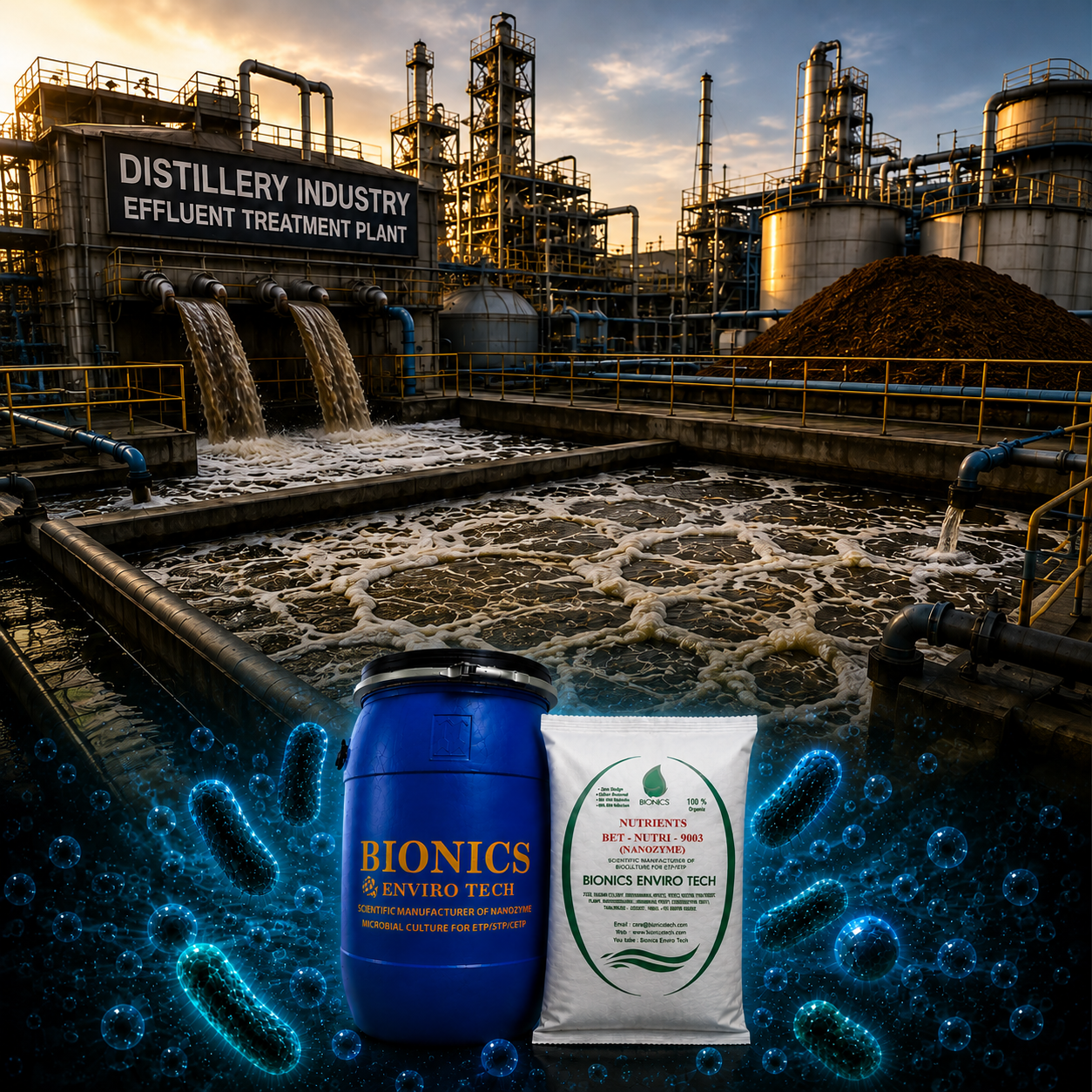
Bionics Nanozyme bioculture supports distillery industry wastewater treatment where spent wash, fermenter sludge and high-strength organic loads require controlled anaerobic digestion and downstream polishing.
Industry overview
Distillery Industry
Molasses-based distilleries generate spent wash or vinasse, fermenter sludge, spent lees, equipment-washing streams and utility wastewater. Spent wash is typically the dominant high-strength stream, while characteristics vary with feedstock, fermentation and alcohol-recovery operation.
Anaerobic digestion converts compatible biodegradable organics through hydrolysis, acidogenesis, acetogenesis and methanogenesis. Stable performance depends on controlled loading, pH, alkalinity, temperature, VFA balance, sulphate and toxicity—not microbial addition alone.
Bionics Nanozyme anaerobic culture supports an assessed digester and recovery programme, followed by suitable aerobic polishing and final treatment. Product selection and dosing depend on wastewater analysis, reactor design and operating trends.
Wastewater Characteristics
Distillery Industry Wastewater Characteristics
Distillery Industry wastewater varies with raw materials, production schedules and cleaning operations. Assessment is required before biological application.
| Parameter | Typical Range |
|---|---|
| COD and BOD | Very high and feedstock/process dependent |
| pH | Often acidic before controlled neutralisation and digestion |
| Spent Wash / Vinasse | High-strength stream requiring dedicated treatment |
| Colour | Dark, recalcitrant and potentially requiring advanced polishing |
| TDS and Salts | High and not removed by biological treatment alone |
| Sulphate / Sulphide Risk | Requires monitoring because sulphide can inhibit methanogenesis and create odour |
| VFA and Alkalinity | Critical indicators of anaerobic digester stability |
| Temperature and Loading | Must remain within the reactor design envelope |
Major Pollutants
Common Contaminants in Industrial Streams
The biological treatment approach targets the main pollutants that influence process reliability and discharge quality.
Spent-Wash Organics
Molasses-derived biodegradable organics create very high COD and BOD loads.
Dark Colour Compounds
Recalcitrant colour may persist after digestion and require dedicated polishing.
Salts and Sulphate
High dissolved solids and sulphate can constrain biological performance.
Fermenter Solids and Sludge
Yeast sludge and suspended material require controlled separation and handling.
Industry Challenges
Distillery Industry Wastewater Treatment Challenges
Distillery treatment depends on spent-wash feed control, pH, alkalinity, VFA balance, sulphide management and stable anaerobic digestion.
Extreme Organic Loading
Uncontrolled spent-wash feed can acidify or overload the digester.
VFA Accumulation
Acid production exceeding methanogenic conversion reduces stability.
pH and Alkalinity Control
Methanogens require a stable buffered environment.
Sulphide Inhibition
Sulphate reduction can create hydrogen sulphide, toxicity and odour.
Biogas Variability
Gas rate and methane content reflect feed quality and digester health.
Residual Colour and TDS
Anaerobic digestion does not alone resolve every reuse or discharge parameter.
How Nanozyme Works
Biological Treatment Pathway
A structured process designed to convert difficult wastewater streams into stable, treatable effluent.
Spent-Wash Characterisation and Feed Balancing
Equalisation and pH/Alkalinity Control
Nanozyme-Supported Anaerobic Digestion
Biogas Collection and Monitoring
Solid-Liquid Separation
Aerobic Biological Polishing
Required Colour, TDS or Reuse Treatment
Biological Treatment Mechanism
Stepwise Biological Conversion
Nanozyme supports the biological process from hydrolysis through mineralization.
Hydrolysis
Complex carbohydrates, proteins and lipids are converted into soluble monomers.
Acidogenesis
Fermentative bacteria convert monomers into volatile fatty acids, gases and intermediates.
Acetogenesis
Intermediate acids are converted mainly into acetate, hydrogen and carbon dioxide.
Methanogenesis
Methanogenic archaea convert acetate or hydrogen and carbon dioxide into methane-rich biogas.
Operating Review
Feed rate, pH, alkalinity, VFA, temperature, gas and outlet trends guide application.
Scientific Reaction Section
Useful Engineering Reactions
Concise reaction pathways that support practical treatment understanding and plant engineering decisions.
Anaerobic Digestion Sequence
Complex organics → monomers → VFAs → acetate/H₂/CO₂ → CH₄ + CO₂
A simplified pathway linking hydrolysis, acidogenesis, acetogenesis and methanogenesis.
Alcoholic Fermentation
C₆H₁₂O₆ → 2 C₂H₅OH + 2 CO₂
Describes ethanol production and is distinct from wastewater-treatment performance.
Sulphate Reduction Risk
SO₄²⁻ + organic electron donor → H₂S + alkalinity products
Competes with methanogenesis and requires sulphate and sulphide monitoring.
Why Nanozyme
Bionics Bioculture Solutions for Distillery Industry Wastewater Treatment
Nanozyme bioculture supports the existing biological treatment stage after wastewater characteristics, pretreatment and operating conditions have been assessed.
Digester Startup Support
Supports controlled microbial establishment in new or recovering anaerobic systems.
Anaerobic Consortia Support
Supports the staged conversion of compatible biodegradable organics.
Load-Recovery Support
Supports recovery after feed, pH, alkalinity or toxicity causes are controlled.
Biogas-Process Stability
Supports biological conditions associated with stable methane generation.
Odour Management
Balanced digestion and sulphide management can help control odour.
Integrated Treatment
Can support anaerobic digestion and assessed aerobic polishing within a complete treatment train.
Product Recommendation
BIONICS NANO-DIST-ANA-2000
| Available Form | Anaerobic microbial bioculture formulation |
| Bacterial Count | Application-specific anaerobic microbial consortium; confirm current approved specification before supply |
| Shelf Life | Minimum one year |
| Recommended Dosage | Application-specific. The supplied 5 MLD programme must not be applied universally; final activation volume and dose require reactor and wastewater evaluation. |
| Incubation Method | Pre-activation and controlled application according to the approved site-specific procedure |
| Suitable Industries | Molasses and compatible ethanol-distillery anaerobic treatment systems |
| Preferred Application | Assessed anaerobic digester after feed balancing, pH and alkalinity review |
Performance Table
Distillery Industry Wastewater Treatment Performance
Treatment response is application-dependent and varies with wastewater characteristics, source control, pretreatment, process design, dosage and plant operation.
| Parameter | Before | After | Reduction % |
|---|---|---|---|
| COD | Very high / variable | Reduced through staged treatment | Application dependent |
| BOD | Very high / variable | Reduced through staged treatment | Application dependent |
| VFA / Alkalinity | Potentially unstable | Monitored and balanced | Operating-control indicator |
| Biogas | Variable | Stabilised where conditions permit | Reactor and feed dependent |
| Colour | Dark | Partly reduced / polished | Dedicated polishing may be required |
| TDS | High | High / process dependent | Not removed by biology alone |
| Odour | Possible | Managed | Sulphide and process dependent |
Applications
Where the Solution Is Applied
Frequently Asked Questions
Technical Answers for Plant Operators and Engineers
Clear answers to the most common implementation and performance questions.
Related Bionics solutions
Continue Your Distillery Industry Wastewater Treatment Research
Review the relevant Bionics product range and supporting information before requesting an application-specific recommendation.
Industry benefits
Expected operational advantages

Distillery Industry
Anaerobic Digester Support
- Problem
- Variable feed and acidification risk reduced digester stability.
- Solution
- BET anaerobic bioculture with pH, alkalinity and loading review.
- Results
- More consistent digestion and operating confidence.
“Recommended where anaerobic performance is monitored with reliable plant data.”
Confidential Client
Process Head · Verified Distillery
Downloads and related industries
Technical information for Distillery Industry
Need a tailored solution for your distillery industry ETP?
Share spent-wash analysis, reactor design, loading, VFA, alkalinity, pH and biogas trends for an application-specific Nanozyme recommendation.