

Sewage Treatment Plant
Sewage Treatment Plant
Nanozyme biological support for municipal, commercial and decentralised sewage treatment plants
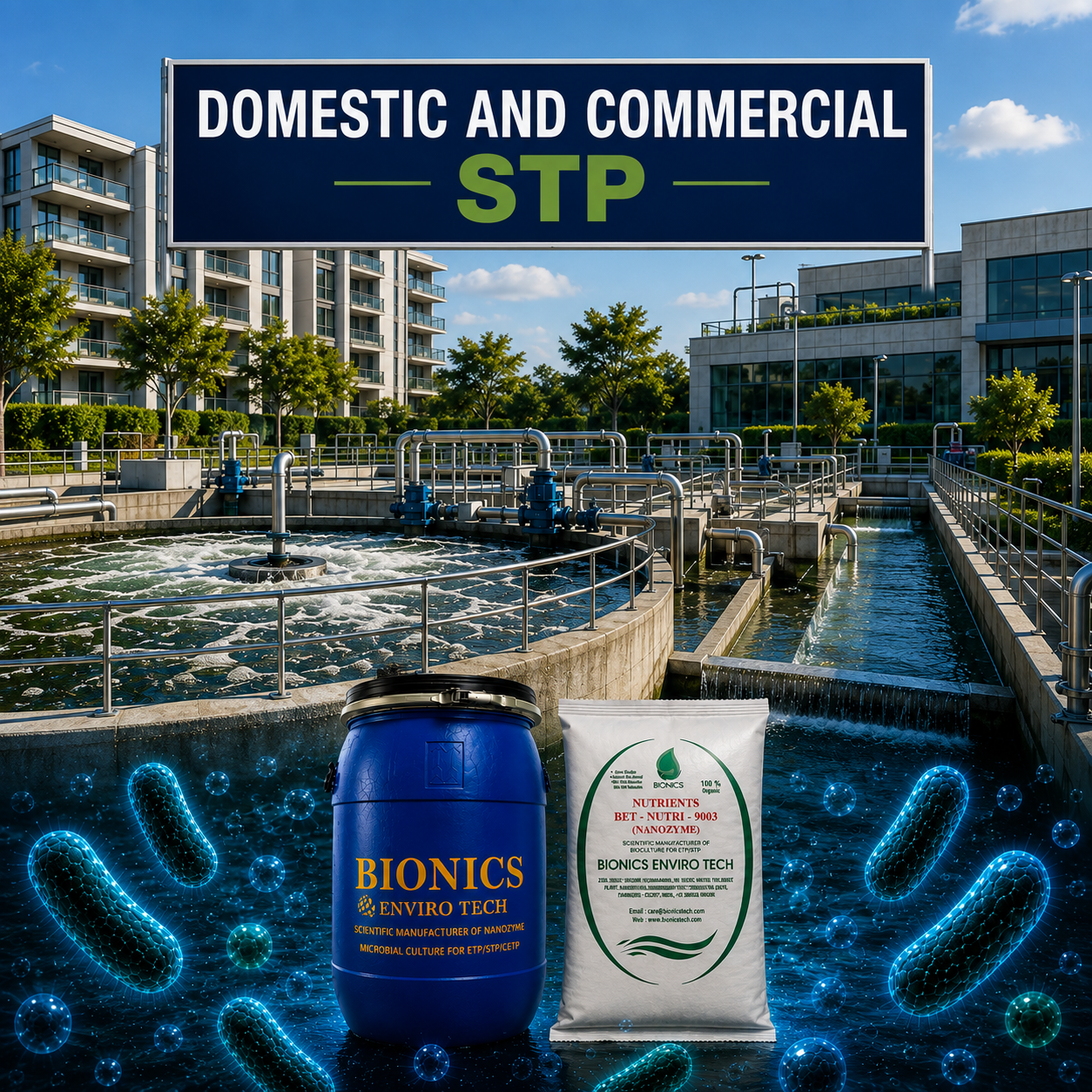
Bionics Nanozyme STP bioculture supports sewage wastewater treatment where variable organic load, ammonia, odour and biomass instability affect biological plant performance.
Industry overview
Sewage Treatment Plant (STP)
Sewage treatment plants receive wastewater containing biodegradable organic matter, suspended solids, nitrogen, phosphorus, household chemicals, fats and microorganisms. Flow and load can vary with occupancy, time of day, rainfall ingress and operating conditions.
Primary treatment removes screenings, grit and settleable solids before biological processes reduce compatible dissolved and colloidal organic loads. Nitrification and biological phosphorus removal require their own operating conditions, while pathogen control requires a validated disinfection stage.
Bionics Nanozyme BET-STP bioculture supports biomass establishment, organic-load conversion and recovery in assessed municipal, commercial, residential and decentralised STP systems. It complements—not replaces—screening, aeration, clarification, sludge handling and disinfection.
Wastewater Characteristics
Sewage Treatment Plant (STP) Wastewater Characteristics
Sewage Treatment Plant (STP) wastewater varies with raw materials, production schedules and cleaning operations. Assessment is required before biological application.
| Parameter | Typical Range |
|---|---|
| BOD and COD | Variable biodegradable organic load from domestic and commercial sewage |
| TSS | Suspended and settleable organic and inorganic solids |
| Ammoniacal Nitrogen | Requires suitable aerobic nitrification conditions |
| Phosphorus | Removal depends on biological or chemical process design |
| FOG | Grease-bearing streams require effective interception and management |
| Pathogens | Require validated downstream disinfection before reuse or discharge |
| Flow and Shock Load | Changes with occupancy, peak hours and infiltration |
| pH and Temperature | Must remain suitable for the installed biological process |
Major Pollutants
Common Contaminants in Industrial Streams
The biological treatment approach targets the main pollutants that influence process reliability and discharge quality.
Biodegradable Organics
Food residues, human waste and household organics contribute BOD and COD.
Suspended Solids
Settleable and floatable matter requires effective primary treatment and clarification.
Ammoniacal Nitrogen
Nitrification requires aerobic conditions, adequate alkalinity and sufficient retention time.
Pathogens
Bacteria, viruses and parasites require validated disinfection; bioculture is not a disinfectant.
Industry Challenges
Sewage Treatment Plant (STP) Wastewater Treatment Challenges
STP performance depends on hydraulic control, aeration, biomass retention, settling, sludge management and validated disinfection.
Variable Hydraulic Load
Peak flows and infiltration can shorten retention time and disturb settling.
Low Dissolved Oxygen
Insufficient aeration limits carbon oxidation and nitrification.
Odour Formation
Septic conditions and poor solids management can produce hydrogen sulphide and other odours.
Biomass Washout
Hydraulic shock, toxicity or poor settling can reduce active biomass.
FOG and Blockages
Grease and solids can interfere with collection, aeration and treatment equipment.
Sludge Handling
Primary and biological sludge require routine wasting, treatment and compliant disposal.
How Nanozyme Works
Biological Treatment Pathway
A structured process designed to convert difficult wastewater streams into stable, treatable effluent.
Screening and Grit Removal
Equalisation or Primary Treatment
Nanozyme-Supported Biological Treatment
Secondary Clarification
Sludge Return and Wasting
Required Tertiary Treatment
Validated Disinfection for Reuse or Discharge
Biological Treatment Mechanism
Stepwise Biological Conversion
Nanozyme supports the biological process from hydrolysis through mineralization.
STP Assessment
Flow, organic load, ammonia, aeration, biomass and settling conditions are reviewed.
Culture Preparation
The selected BET-STP grade is activated through the approved procedure.
Controlled Application
Prepared culture is introduced into the assessed biological stage.
Organic-Load Conversion
Microbial enzymes hydrolyse compatible organics before biological uptake and oxidation.
Operating Review
DO, pH, loading, ammonia, settling and outlet trends guide maintenance application.
Scientific Reaction Section
Useful Engineering Reactions
Concise reaction pathways that support practical treatment understanding and plant engineering decisions.
Aerobic Carbon Conversion
Biodegradable organics + O₂ → CO₂ + H₂O + biomass
A simplified representation of aerobic organic-load treatment.
Nitrification
NH₄⁺ → NO₂⁻ → NO₃⁻
Requires adequate oxygen, alkalinity, retention time and non-inhibitory conditions.
Biological Phosphorus Uptake
Soluble phosphorus → phosphorus-rich biomass
Applicable only where the STP is configured and operated for enhanced biological phosphorus removal.
Why Nanozyme
Bionics Bioculture Solutions for Sewage Treatment Plant (STP) Wastewater Treatment
Nanozyme bioculture supports the existing biological treatment stage after wastewater characteristics, pretreatment and operating conditions have been assessed.
Startup and Recovery Support
Supports microbial establishment in new or recovering biological systems.
Biomass Stability
Helps maintain biological activity through managed load variation.
Organic-Load Support
Supports biological BOD and COD reduction for compatible sewage organics.
Odour Management
Improved aerobic balance can help manage biodegradable odour sources.
Settling Support
Stable biomass and operating control can support better floc formation and clarification.
Existing-STP Integration
Can support activated-sludge, MBBR, SBR and compatible biological processes after assessment.
Product Recommendation
NANOZYME-BET-STP-9013
| Available Form | Organic semi-solid form |
| Bacterial Count | 52 different living cultures · BET-STP-9013: 42 × 10⁹ CFU/mL |
| Shelf Life | Minimum one year |
| Recommended Dosage | Application-specific. Final grade, activation volume and maintenance dose must follow plant capacity, influent quality, biomass condition and technical evaluation. |
| Incubation Method | Pre-activation and controlled dosing according to the approved application procedure |
| Suitable Industries | Municipal, residential, commercial, institutional and decentralised sewage treatment systems |
| Preferred Application | Assessed biological treatment stage, commonly the aeration or biological reactor |
Performance Table
Sewage Treatment Plant (STP) Wastewater Treatment Performance
Treatment response is application-dependent and varies with wastewater characteristics, source control, pretreatment, process design, dosage and plant operation.
| Parameter | Before | After | Reduction % |
|---|---|---|---|
| COD | High / variable | Reduced | Company source states up to 98% |
| BOD | High / variable | Reduced | Company source states up to 98% |
| TSS | Elevated | Reduced | Process and clarification dependent |
| Ammonia | Present | Converted under nitrifying conditions | Operating-condition dependent |
| Odour | Possible under septic conditions | Managed | Application dependent |
| Sludge | Plant dependent | Managed | No zero-sludge guarantee |
| Pathogens | Present | Requires disinfection | Not a bioculture performance claim |
Applications
Where the Solution Is Applied
Frequently Asked Questions
Technical Answers for Plant Operators and Engineers
Clear answers to the most common implementation and performance questions.
Related Bionics solutions
Continue Your Sewage Treatment Plant (STP) Wastewater Treatment Research
Review the relevant Bionics product range and supporting information before requesting an application-specific recommendation.
Industry benefits
Expected operational advantages
Textile Industry
Biological ETP Stabilisation
- Problem
- Variable washing and finishing loads caused recurring biomass stress.
- Solution
- A monitored Nanozyme aerobic bioculture programme integrated with existing plant controls.
- Results
- More stable biology, improved settling and fewer process interventions.
“Recommended for textile plants seeking structured biological-treatment support.”
Confidential Client
Plant Head · Verified Textile Manufacturer
Downloads and related industries
Technical information for Sewage Treatment Plant (STP)
Need a tailored solution for your sewage treatment plant?
Share plant capacity, process configuration, influent and outlet analysis, aeration data and biomass condition for an application-specific BET-STP recommendation.