

Dye Processing Industry Wastewater Treatment
Dye Processing Industry Wastewater Treatment
Biological treatment support for colour-bearing and chemically complex dye wastewater
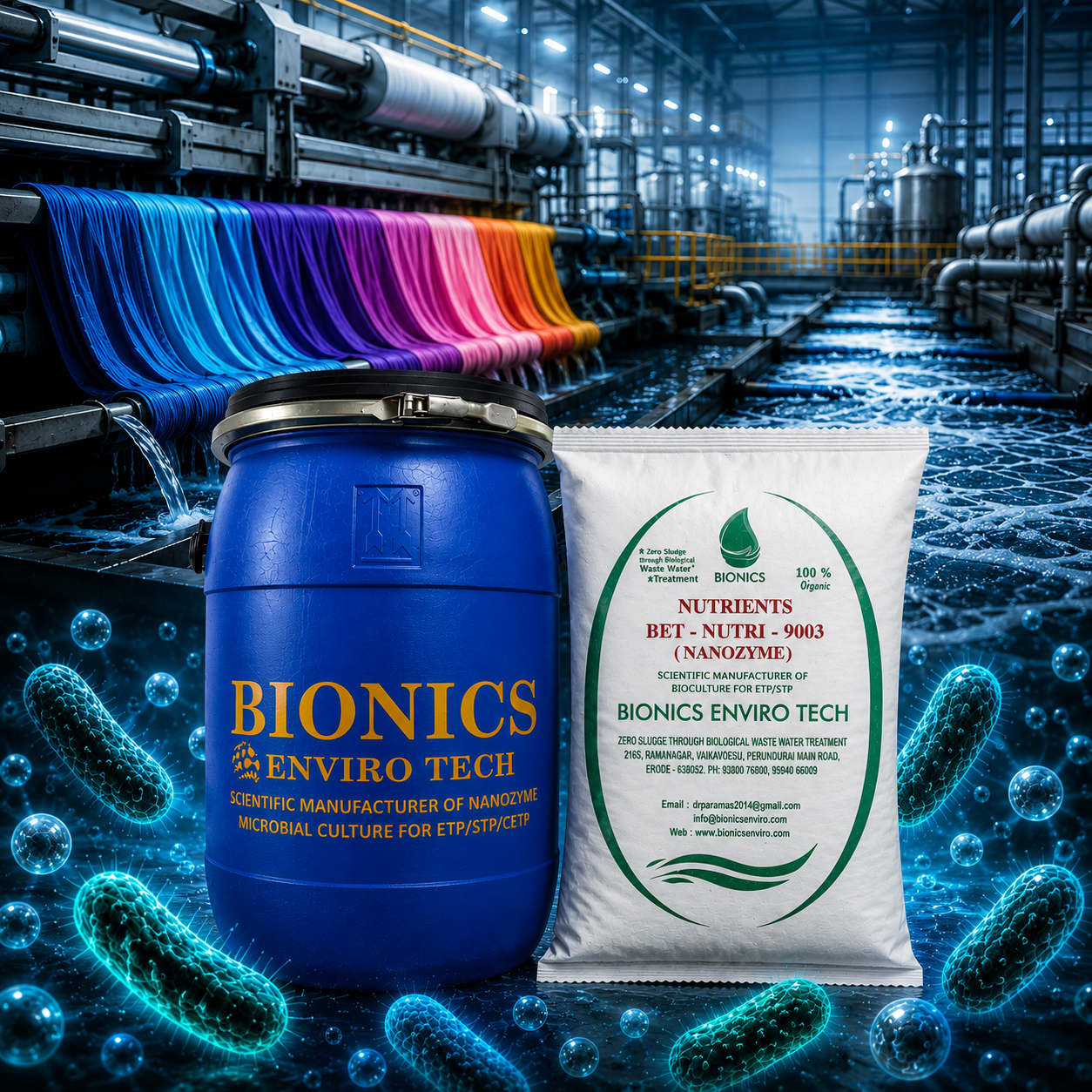
Designed for dye houses and processing units managing intense colour, azo compounds, salts, surfactants and fluctuating chemical loads.
Industry overview
Dye Processing Industry
Dye manufacturing and dyeing operations produce intensely coloured wastewater containing complex organic dyes, auxiliaries, salts, surfactants and variable pH.
These compounds can inhibit conventional biomass and make colour and COD reduction difficult without effective equalisation and biological process control.
Nanozyme bioculture supports resilient microbial activity in the biological stage, complementing the plant's physical and chemical colour-removal processes.
Wastewater Characteristics
Dye Processing Industry Wastewater Characteristics
Dye Processing Industry wastewater varies with raw materials, production schedules and cleaning operations. Assessment is required before biological application.
| Parameter | Typical Range |
|---|---|
| pH | Highly variable; requires correction |
| COD | High to very high |
| BOD | Variable biodegradability |
| Colour | Intense and persistent |
| TDS / Salinity | Often elevated |
| Surfactants | Process dependent |
| Shock Load | Frequent batch variation |
Major Pollutants
Common Contaminants in Industrial Streams
The biological treatment approach targets the main pollutants that influence process reliability and discharge quality.
Azo and Reactive Dyes
Persistent colour-bearing compounds that require a combined treatment strategy.
Dye Auxiliaries
Fixing agents and processing chemicals add COD and may inhibit biomass.
Salts and TDS
Elevated conductivity can reduce biological activity and requires plant-specific assessment.
Surfactants
Wetting and dispersing agents can create foam and affect oxygen transfer.
Heavy Metals
Some colourants may introduce metals that require source control and monitoring.
Recalcitrant Organics
Poorly biodegradable compounds can remain after conventional treatment.
Industry Challenges
Dye Processing Industry Wastewater Treatment Challenges
Dye ETP performance depends on dye chemistry, salinity, toxicity, redox conditions, biomass stability and effective colour polishing.
Persistent Colour
Residual colour can remain even after substantial organic-load reduction.
Toxicity
Dyes and auxiliaries may suppress microbial growth and recovery.
Salinity
High salt concentrations can stress non-acclimatised biomass.
Batch Variation
Changing shades and recipes create sudden pH and load fluctuations.
Foaming
Surfactants can interfere with aeration and settling.
Low Biodegradability
Complex molecules may need pretreatment before biological polishing.
How Nanozyme Works
Biological Treatment Pathway
A structured process designed to convert difficult wastewater streams into stable, treatable effluent.
Segregation
Equalisation
pH Correction
Required Pretreatment
Nanozyme-Supported Biology
Clarification
Colour Polishing
Biological Treatment Mechanism
Stepwise Biological Conversion
Nanozyme supports the biological process from hydrolysis through mineralization.
Dye-Stream Assessment
Dye class, colour, COD/BOD, salinity, toxicity and biomass condition are reviewed.
Required Pretreatment
Source control and appropriate chemical, physical or anaerobic steps are selected for the stream.
Controlled Bioculture Application
The activated BET-ETP grade is introduced into the assessed biological stage.
Compatible Dye-Bond Transformation
Enzymatic pathways may support transformation of compatible dye structures under suitable redox conditions.
Colour Polishing Review
Residual colour, toxicity, TDS and outlet trends determine downstream polishing needs.
Scientific Reaction Section
Useful Engineering Reactions
Concise reaction pathways that support practical treatment understanding and plant engineering decisions.
Azo-Bond Reduction Where Applicable
R–N=N–R′ → aromatic amine intermediates
Azoreductase-supported cleavage may occur under suitable reducing conditions; intermediates require subsequent treatment and toxicity assessment.
Aerobic Transformation and Polishing
Compatible intermediates + O₂ → smaller oxidised products
Aerobic treatment may support further degradation but does not guarantee complete mineralisation of every dye.
Why Nanozyme
Bionics Bioculture Solutions for Dye Processing Industry Wastewater Treatment
Nanozyme bioculture supports the existing biological treatment stage after wastewater characteristics, pretreatment and operating conditions have been assessed.
Compatible Dye-Load Support
Supports biological transformation of assessed biodegradable dye-related organics.
Biomass Stability
Helps maintain activity after salinity, toxicity and pH conditions are controlled.
Shock-Load Recovery
Supports recovery after the inhibitory source and operating conditions are managed.
Colour-Process Integration
Works as part of a combined treatment train with required colour polishing.
Odour Management
Stable biological operation can help manage biodegradable odour sources.
CETP Application Support
Can support an assessed shared biological stage with disciplined influent control.
Product Recommendation
NANOZYME-BET-ETP-7003
| Available Form | Organic semi-solid form |
| Bacterial Count | 62 different living cultures · BET-ETP-7003: 35 × 10⁹ CFU/mL |
| Shelf Life | Minimum one year |
| Recommended Dosage | Application-specific. Final grade, activation volume and dose must follow dye chemistry, colour, salinity, toxicity, plant capacity and technical evaluation. |
| Incubation Method | Pre-activation and controlled dosing according to the approved application procedure |
| Suitable Industries | Dye houses, dye manufacturing units, CETP and colour-bearing ETP systems |
| Preferred Application | Assessed biological stage after segregation, equalisation and required pretreatment |
Performance Table
Dye Processing Industry Wastewater Treatment Performance
Treatment response is application-dependent and varies with wastewater characteristics, source control, pretreatment, process design, dosage and plant operation.
| Parameter | Before | After | Reduction % |
|---|---|---|---|
| COD | High / variable | Reduced | Application dependent |
| BOD | Variable biodegradability | Reduced | Application dependent |
| Colour | Intense / persistent | Reduced and polished | Dye and process dependent |
| TSS | Elevated | Controlled | Clarification dependent |
| TDS / Salinity | Often high | Process dependent | Not removed by biology alone |
| Toxicity | Dye dependent | Requires verification | Treatability and testing dependent |
Applications
Where the Solution Is Applied
Frequently Asked Questions
Technical Answers for Plant Operators and Engineers
Clear answers to the most common implementation and performance questions.
Related Bionics solutions
Continue Your Dye Processing Industry Wastewater Treatment Research
Review the relevant Bionics product range and supporting information before requesting an application-specific recommendation.
Industry benefits
Expected operational advantages

Dye Processing Industry
Colour-Load Biological Stabilisation
- Problem
- Changing dye recipes, surfactants and colour shocks affected biomass stability.
- Solution
- Nanozyme-supported biological treatment was integrated with equalisation and the existing colour-removal process.
- Results
- Improved biological stability and more consistent downstream colour polishing.
“Suitable where dye-house operators combine biological support with disciplined source and process control.”
Confidential Client
ETP Manager · Verified Dye Processing Unit
Downloads and related industries
Technical information for Dye Processing Industry
Need a tailored solution for your dye processing industry ETP?
Share dye classes, colour, salinity, wastewater analysis and treatment process for an application-specific Nanozyme recommendation.