

Chemical Industry Wastewater Treatment
Chemical Industry Wastewater Treatment
Nanozyme bioculture support for chemical industry ETP and biological treatment
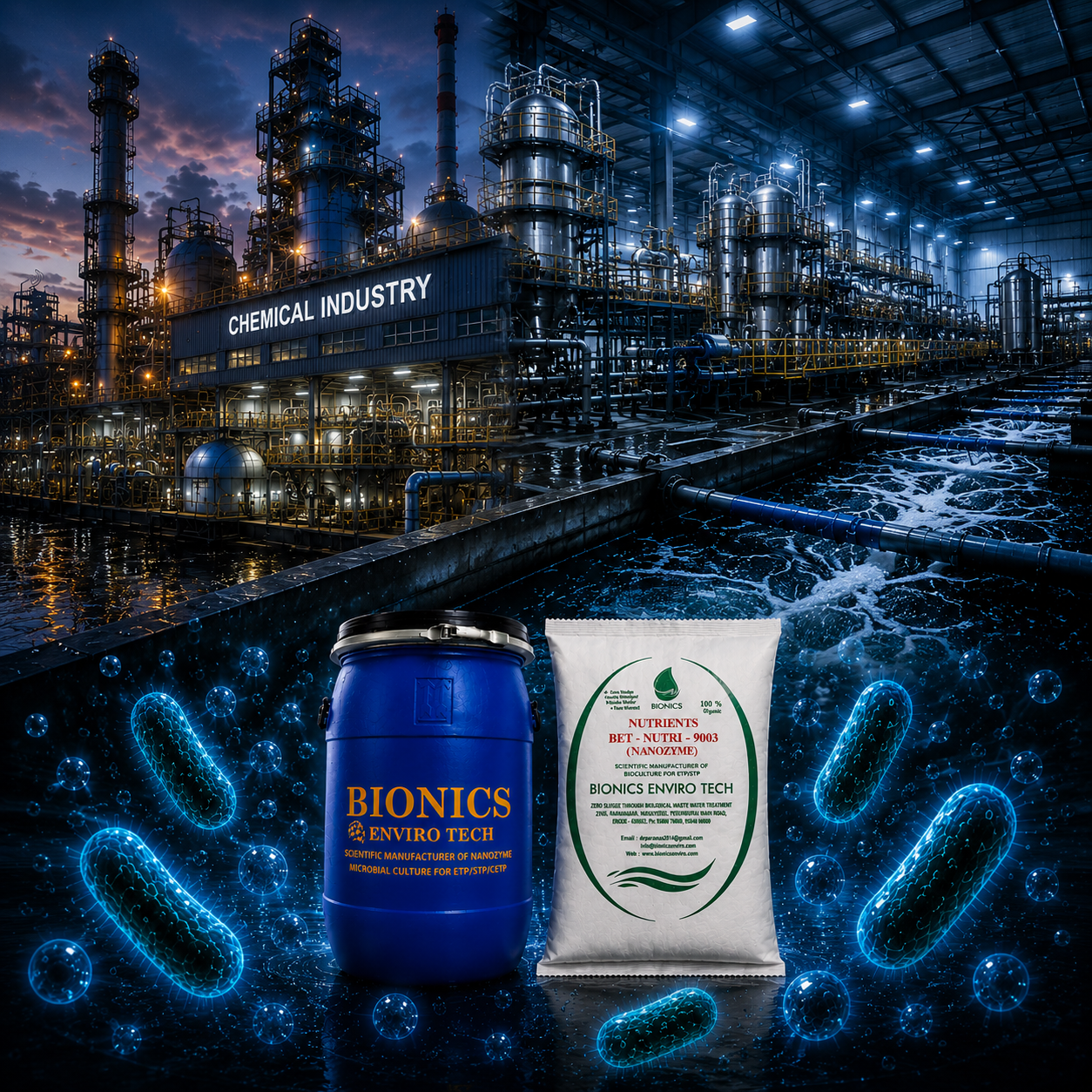
Bionics Nanozyme bioculture supports chemical industry wastewater treatment where variable organic loads, inhibitory compounds and process changes can affect ETP biology.
Industry overview
Chemical Industry
Chemical manufacturing facilities can generate wastewater with changing pH, organic load and inhibitory compounds. Solvents, phenolics and surfactants may interfere with biomass activity, oxygen transfer and settling when they enter the biological stage without adequate control.
Bionics Enviro Tech uses Nanozyme bioculture to support the aerobic biological stage of a chemical industry ETP. The formulation is intended to strengthen microbial activity and help the existing treatment process respond more consistently to biodegradable organic load and controlled influent variation.
Product selection and application must be based on wastewater analysis, toxicity, equalisation performance, pH, dissolved oxygen, biomass condition and the installed treatment process. Nanozyme supports biological treatment; it does not replace required source control, pretreatment, solids separation or final polishing.
Wastewater Characteristics
Chemical Industry Wastewater Characteristics
Chemical Industry wastewater varies with raw materials, production schedules and cleaning operations. Assessment is required before biological application.
| Parameter | Typical Range |
|---|---|
| pH | Process dependent; correction may be required before biological treatment |
| Organic Load | Variable COD and BOD from production and cleaning streams |
| Biodegradability | Depends on the chemical composition of the wastewater |
| Toxicity / Inhibition | Requires assessment before biological application |
| Solvents and Phenolics | Process specific and potentially inhibitory |
| Surfactants | May affect foaming, oxygen transfer and settling |
| Flow and Shock Load | Can vary with batch production and wash cycles |
| Dissolved Oxygen | Must be monitored in aerobic treatment stages |
Major Pollutants
Common Contaminants in Industrial Streams
These process-specific contaminants may inhibit biology or require source control and pretreatment. Their biodegradability must be assessed before application.
Phenols
Require stable and acclimatized bioactivity for effective removal.
Volatile Organic Compounds
Process-specific volatile compounds can challenge biological treatment and require assessment.
Solvents
Residual solvent-bearing organics can inhibit or disrupt microbial performance.
Surfactants
Increase foam and reduce oxygen transfer efficiency.
Industry Challenges
Chemical Industry Wastewater Treatment Challenges
Chemical ETP performance depends on controlling variable influent, inhibitory compounds, shock loads and biological operating conditions.
Variable Influent
Batch production and cleaning cycles can change flow, pH and organic loading.
Microbial Inhibition
Toxic or poorly controlled compounds can suppress biological activity.
Shock Loading
Sudden chemical or organic loads can destabilize an acclimatized biomass.
Foaming and Oxygen Transfer
Surfactants and high load can reduce effective aeration performance.
Odour Formation
Unbalanced biological conditions may allow odour-forming compounds to persist.
Sludge Stability
Inhibition and load variation can affect floc formation, settling and sludge handling.
How Nanozyme Works
Biological Treatment Pathway
A structured process designed to convert difficult wastewater streams into stable, treatable effluent.
Wastewater Characterization
Segregation and Equalisation
pH Correction Where Required
Required Pretreatment
Nanozyme-Supported Aerobic Treatment
Clarification
Required Final Polishing
Biological Treatment Mechanism
Stepwise Biological Conversion
Nanozyme supports the biological process from hydrolysis through mineralization.
Wastewater Assessment
Influent chemistry, toxicity, organic load and biomass condition are reviewed before application.
Culture Preparation
The selected Nanozyme grade is prepared through the approved activation procedure.
Controlled Dosing
Prepared culture is introduced into the biological treatment stage according to the approved dose plan.
Biological Support
Living cultures support degradation of compatible biodegradable organics in the aerobic process.
Operating Review
pH, dissolved oxygen, loading, biomass response and outlet trends guide further application.
Scientific Reaction Section
Useful Engineering Reactions
Concise reaction pathways that support practical treatment understanding and plant engineering decisions.
Biological Organic-Matter Oxidation
Biodegradable organics + O₂ → CO₂ + H₂O + biomass
Represents aerobic conversion of compatible biodegradable organic load under controlled ETP conditions.
Nitrogen Conversion Where Applicable
NH₄⁺ + O₂ → NO₂⁻ → NO₃⁻
Relevant only where nitrogen-bearing wastewater and suitable nitrification conditions are present.
Why Nanozyme
Bionics Bioculture Solutions for Chemical Industry Wastewater Treatment
Nanozyme bioculture supports the existing biological treatment stage after wastewater characteristics, pretreatment and operating conditions have been assessed.
Biomass Stability
Supports healthier aerobic microbial activity under controlled chemical-industry ETP conditions.
Organic Load Support
Assists biological COD and BOD removal for compatible biodegradable wastewater fractions.
Variable Load Recovery
Supports recovery after the inhibitory source and operating condition have been controlled.
Odour Management
Improved biological balance can help reduce biodegradable odour-forming compounds.
Sludge Management
Improved organic conversion may reduce excess biological sludge generation.
Existing-Plant Integration
Can be applied within an existing biological treatment process after technical assessment.
Product Recommendation
NANOZYME-BET-ETP-7003
| Available Form | Organic semi-solid form |
| Bacterial Count | 62 different living cultures · BET-ETP-7003: 35 × 10⁹ CFU/mL |
| Shelf Life | Minimum one year |
| Recommended Dosage | Application-specific. Final grade, activation volume and daily dose must be confirmed from wastewater characteristics, plant capacity, ETP configuration and technical evaluation. |
| Incubation Method | Pre-activation and controlled dosing according to the approved application procedure |
| Suitable Industries | Chemical manufacturing ETP and compatible industrial biological treatment systems |
| Preferred Application | Aerobic biological treatment stage after wastewater and process assessment |
Performance Table
Chemical Industry Wastewater Treatment Performance
Treatment response is application-dependent and varies with wastewater characteristics, source control, pretreatment, process design, dosage and plant operation.
| Parameter | Before | After | Reduction % |
|---|---|---|---|
| Sludge Degradation | Process dependent | Application dependent | Company source states zero sludge |
| COD | High / variable | Reduced | 95–98% |
| BOD | High / variable | Reduced | 98–100% |
| Colour | Process dependent | Reduced | 90–100% |
| Odour | Present | Reduced | Company source states 100% |
| Suspended & Floatable Organic Debris | Present | Reduced | Company source states 100% |
| TSS | Elevated | Reduced | 92–95% |
| TDS | Process dependent | Process dependent | Depends on wastewater characteristics |
| Dissolved Oxygen (DO) | Plant dependent | Monitored operating range | Min 3 – Max 8 |
Applications
Where the Solution Is Applied
Frequently Asked Questions
Technical Answers for Plant Operators and Engineers
Clear answers to the most common implementation and performance questions.
Related Bionics solutions
Continue Your Chemical Industry Wastewater Treatment Research
Review the relevant Bionics product range and supporting information before requesting an application-specific recommendation.
Industry benefits
Expected operational advantages
Chemical Industry
Shock Load Recovery
- Problem
- Intermittent inhibitory loads weakened aerobic biomass.
- Solution
- Controlled Nanozyme dosing supported by equalisation and toxicity management.
- Results
- Faster biological recovery after production-load variation.
“A dependable biological support programme for demanding ETP conditions.”
Confidential Client
Technical Manager · Verified Chemical Manufacturer
Downloads and related industries
Technical information for Chemical Industry
Need a tailored solution for your chemical industry ETP?
Share your wastewater analysis, ETP process, operating data and treatment objective for an application-specific Nanozyme bioculture recommendation.