

Municipal Solid Waste Composting
Nanozyme Culture for Municipal Solid Waste Composting
Faster organic waste degradation with improved compost quality
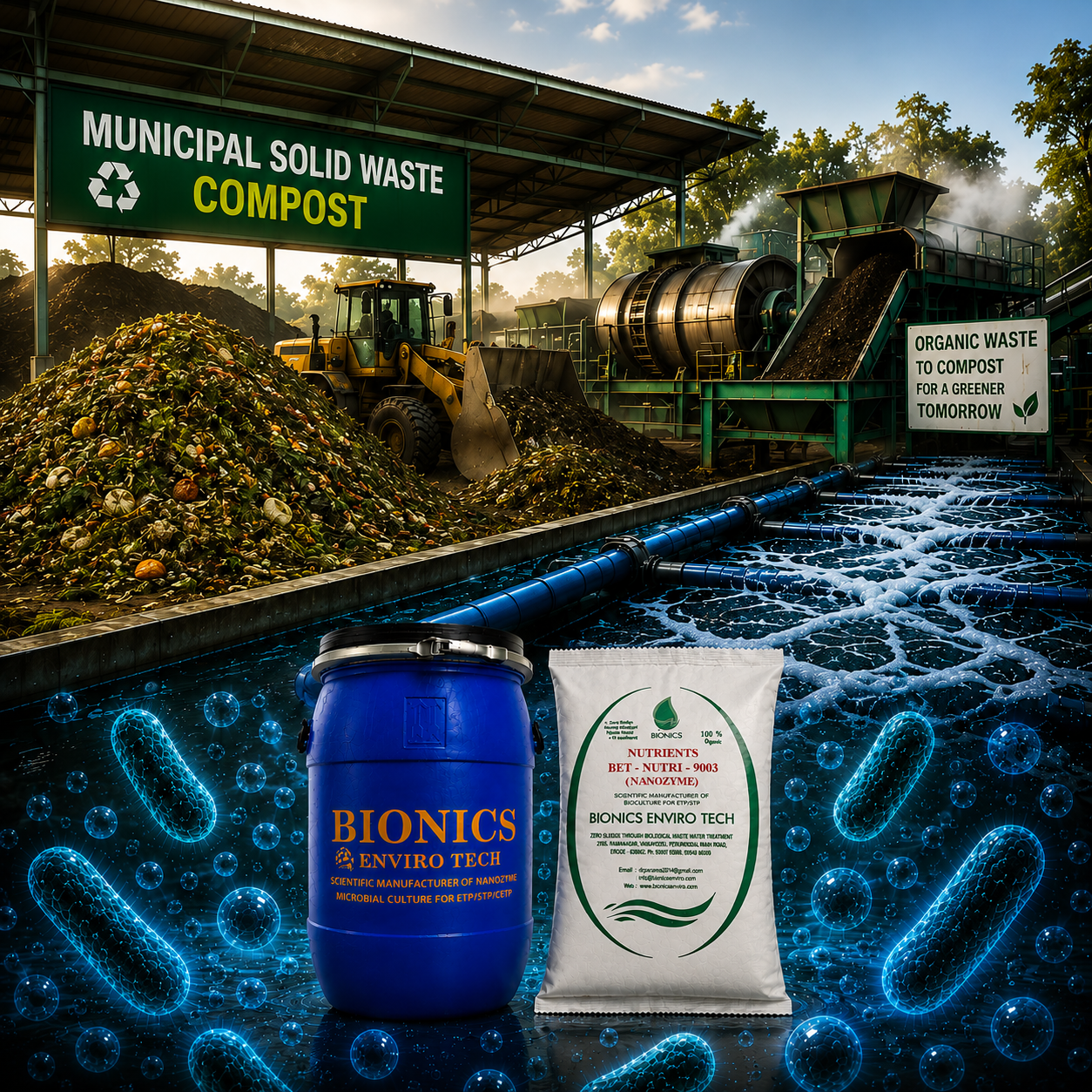
A biological composting solution that accelerates decomposition, controls odour and supports stable curing of municipal organic waste.
Industry overview
Municipal Solid Waste Composting
Municipal organic waste can be converted into a stable soil-conditioning resource when feedstock preparation, carbon-to-nitrogen balance, moisture, oxygen and temperature are controlled.
Nanozyme BET-COMP-7103 supplies a living aerobic microbial consortium that supports decomposition through mesophilic, thermophilic, cooling and maturation stages.
The formulation can be applied to segregated municipal organics, food waste, garden waste and suitable press-mud or treated spent-wash composting programmes after process assessment.
Composting Parameters
Typical Composting Conditions
Key feedstock and environmental conditions that influence microbial activity and finished-compost quality.
| Parameter | Typical Range |
|---|---|
| Recommended pH | 6.0–7.5 |
| Target C:N Ratio | 25:1–30:1 |
| Active Temperature | 40–65°C |
| Moisture | Controlled for porosity and microbial activity |
| Aeration | Regular turning or forced aeration |
| Particle Size | Prepared for adequate microbial access |
Suitable Feedstock
Organic Materials for Controlled Composting
Segregated biodegradable materials can be blended to balance structure, moisture, carbon and nitrogen.
Food and Market Waste
Readily biodegradable organics that require controlled moisture and aeration.
Garden and Crop Residues
Carbon-rich material that supports structure and feedstock balance.
Press Mud
Sugar-industry organic residue suitable for managed composting programmes.
Treated Spent Wash
Can be incorporated using a controlled and approved composting procedure.
Industry Challenges
Municipal Solid Waste Composting Challenges
Reliable composting depends on segregated feedstock, balanced carbon and nitrogen, suitable moisture, adequate oxygen and controlled temperature.
Unbalanced C:N Ratio
Excess carbon slows degradation while excess nitrogen can increase ammonia odour.
Poor Aeration
Compaction and anaerobic pockets create odour and uneven decomposition.
Moisture Variation
Dry piles slow microbial activity while excessive moisture reduces porosity.
Temperature Control
The active phase must be monitored to support decomposition and sanitation.
How Nanozyme Works
Controlled Composting Pathway
A managed sequence from feedstock preparation through active decomposition, cooling and maturation.
Feedstock Segregation
Size Reduction and Mixing
C:N and Moisture Adjustment
Nanozyme Application
Active Composting
Cooling
Maturation and Screening
Composting Mechanism
Microbial Succession During Composting
Managed microbial activity progresses through mesophilic, thermophilic, cooling and maturation stages.
Mesophilic Activation
Microorganisms begin degrading readily available carbon and nitrogen compounds.
Thermophilic Decomposition
Higher-temperature activity breaks down more complex material and supports sanitation.
Cooling
Mesophilic populations return as available carbon declines.
Maturation
Secondary reactions stabilize organic matter into mature compost.
Scientific Reaction Section
Core Composting Reactions
Simplified aerobic decomposition and nitrogen-transformation pathways relevant to controlled composting.
Aerobic Decomposition
Organic matter + O₂ → CO₂ + H₂O + heat
The primary controlled pathway in an aerated compost pile.
Nitrogen Transformation
Organic N → NH₄⁺ → NO₂⁻ → NO₃⁻
Microbial activity transforms nitrogen as compost stabilizes.
Why Nanozyme
Nanozyme Bioculture for Controlled Organic Waste Composting
BET-COMP-7103 supports a managed aerobic composting programme when feedstock preparation, moisture, aeration and temperature are properly controlled.
Faster Decomposition
Supports active microbial breakdown of mixed organic feedstock.
Odour Control
Better aeration and degradation reduce odour-forming anaerobic pockets.
Temperature Stability
Supports microbial succession through active composting stages.
Improved Compost Quality
Controlled maturation supports a more stable finished product.
Product Recommendation
Nanozyme BET-COMP-7103
| Available Form | Organic semi-solid form |
| Bacterial Count | 48 living cultures · 38 × 10⁹ CFU/mL |
| Shelf Life | Minimum one year |
| Recommended Dosage | Based on feedstock weight and composition |
| Incubation Method | Apply through an approved activation and mixing procedure |
| Suitable Industries | Municipal organics, food waste, agriculture, sugar and distillery |
| Preferred Application | Aerobic windrow or controlled composting |
Performance Table
Controlled Composting Performance Indicators
Composting response varies with feedstock composition, C:N ratio, moisture, aeration, temperature control, mixing and curing.
| Parameter | Before | After | Reduction % |
|---|---|---|---|
| C:N Ratio | Variable feedstock | Balanced mix | Target 25:1–30:1 |
| Odour | Uncontrolled | Managed | Process dependent |
| Organic Volume | Raw feedstock | Reduced and stabilized | Feedstock dependent |
| Compost Stability | Active material | Mature compost | After curing |
Applications
Suitable Organic Waste Applications
Frequently Asked Questions
Municipal Solid Waste Composting Questions
Practical answers covering feedstock preparation, process control, application and compost maturity.
Related Bionics solutions
Continue Your Organic Waste Composting Research
Review the compost culture formulation and supporting company information before requesting a feedstock-specific application recommendation.
Industry benefits
Expected operational advantages

Food Processing
High Organic Load Management
- Problem
- Changing production loads caused inconsistent COD and BOD performance.
- Solution
- Plant assessment, phased activation and routine operating-data review.
- Results
- Improved consistency and a clearer operator response plan.
“The technical implementation support was practical and responsive.”
Confidential Client
Operations Director · Verified Food Processor
Downloads and related industries
Technical information for Municipal Solid Waste Composting
Plan a Controlled Organic Waste Composting Programme
Share feedstock composition, daily quantity and current composting method for an application-specific recommendation.