
Bionics Enviro Tech
AboutWhy Nanozyme
Products
Industries
Resources
CareerContact
Buy Product
How may I help?
Bionics Enviro Tech scientific manufacturer logoBIONICS ENVIRO TECHScientific Manufacturer

Nanozyme Bioculture for industrial and municipal wastewater treatment.

+91 90950 00090info@bionicsenviro.comGST No. 33BKEPS2994G1ZV
  • View All Products
  • Bioculture Manufacturer in India
  • Aerobic Bioculture
  • Anaerobic Bioculture
  • ETP Bioculture
  • STP Bioculture
  • Organic Compost Culture
  • View All Industries
  • Industrial ETP
  • Sewage Treatment Plant
  • Common Effluent Treatment Plant
  • Organic Waste Composting
  • About Us
  • Contact
  • Careers
  • Awards
  • Blogs
  • Case Studies
  • Downloads
  • Testimonials
  • Certificates
  • FAQs

© 2026 Bionics Enviro Tech Pvt. Ltd.

PrivacyTermsDisclaimerSitemap
BlogsHow Beneficial Bacteria Work in Wastewater Treatment
How Beneficial Bacteria Work in Wastewater Treatment

Wastewater Treatment

How Beneficial Bacteria Work in Wastewater Treatment

Follow the biological pathway from complex organic matter to simpler compounds, biomass and treated effluent.

By Bionics Enviro Tech Team - 3 August 2026 - 6 min read
Sharein

Why wastewater needs biological treatment

Domestic sewage and many industrial streams contain biodegradable organic matter. Discharging untreated wastewater can deplete oxygen in receiving water, create odour and introduce public-health and environmental risks.

From complex material to simpler compounds

Microbial enzymes first hydrolyse larger biodegradable molecules. Microorganisms then use the smaller compounds for energy and growth. Under aerobic conditions, simplified end products include carbon dioxide, water and biomass.

Treatment is a managed ecosystem

Bacteria need controlled pH, temperature, nutrients and retention time. Aerobic systems also need sufficient oxygen; anaerobic digesters require stable loading, alkalinity and reactor conditions. Clarification separates biological solids after conversion.

Measuring performance

Operators assess influent and outlet COD, BOD, TSS and other parameters alongside DO, MLSS and settling. These trends show whether the full process—not only the microbial product—is working consistently.
Frequently asked questions

Do bacteria consume all wastewater pollutants?

No. They primarily act on compatible biodegradable material.

Why is oxygen important?

Aerobic microorganisms require oxygen for biological oxidation.

How is performance checked?

By laboratory results and operating data across the treatment process.

About the author

Bionics Enviro Tech Team

Wastewater Treatment Specialists

The Bionics Enviro Tech team helps operators build resilient, compliant biological treatment systems.

Need help improving your ETP or STP?

Talk to our technical team about a bioculture plan tailored to your influent and operating conditions.

Buy NanozymeContact Us

On this page

  1. Why wastewater needs biological treatment
  2. From complex material to simpler compounds
  3. Treatment is a managed ecosystem
  4. Measuring performance

Continue learning

Related articles

What Is Bioculture in Wastewater Treatment?

Bioculture

What Is Bioculture in Wastewater Treatment?

Understand what wastewater bioculture contains, what beneficial microorganisms do and which operating conditions determine performance.

7 Aug 20266 min read
Read article
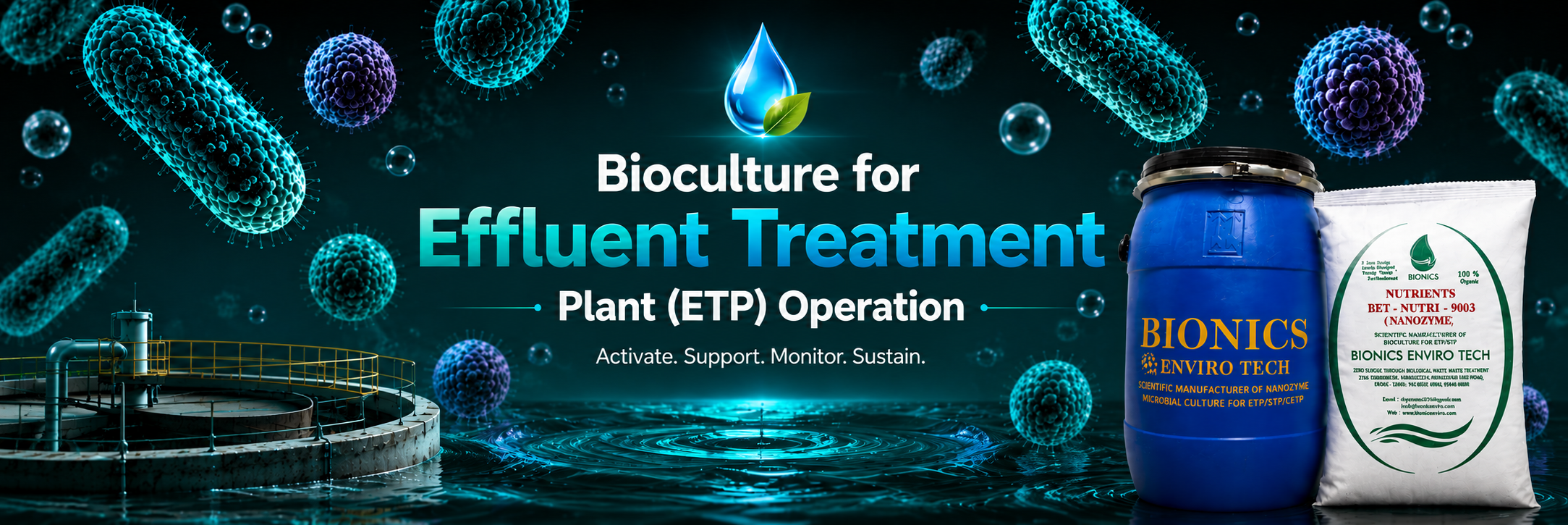
Bioculture for Effluent Treatment Plant (ETP) Operation

ETP

Bioculture for Effluent Treatment Plant (ETP) Operation

A practical guide to selecting, activating and monitoring bioculture in an industrial effluent treatment plant.

6 Aug 20267 min read
Read article
Complete Guide to Bioculture Solutions for Industrial Wastewater Treatment

Bioculture

Complete Guide to Bioculture Solutions for Industrial Wastewater Treatment

Discover how advanced bioculture systems improve biological treatment efficiency across industrial wastewater plants and municipal systems.

10 Jun 20267 min read
Read article
Previous

Nanozyme Microbial Culture for Industrial Wastewater Treatment

Next

Aerobic vs Anaerobic Bacteria Culture for Wastewater Treatment