
Bionics Enviro Tech
AboutWhy Nanozyme
Products
Industries
Resources
CareerContact
Buy Product
How may I help?
Bionics Enviro Tech scientific manufacturer logoBIONICS ENVIRO TECHScientific Manufacturer

Nanozyme Bioculture for industrial and municipal wastewater treatment.

+91 90950 00090info@bionicsenviro.comGST No. 33BKEPS2994G1ZV
  • View All Products
  • Bioculture Manufacturer in India
  • Aerobic Bioculture
  • Anaerobic Bioculture
  • ETP Bioculture
  • STP Bioculture
  • Organic Compost Culture
  • View All Industries
  • Industrial ETP
  • Sewage Treatment Plant
  • Common Effluent Treatment Plant
  • Organic Waste Composting
  • About Us
  • Contact
  • Careers
  • Awards
  • Blogs
  • Case Studies
  • Downloads
  • Testimonials
  • Certificates
  • FAQs

© 2026 Bionics Enviro Tech Pvt. Ltd.

PrivacyTermsDisclaimerSitemap
BlogsSeptic Tank Bacteria Culture: Use, Limits and Maintenance
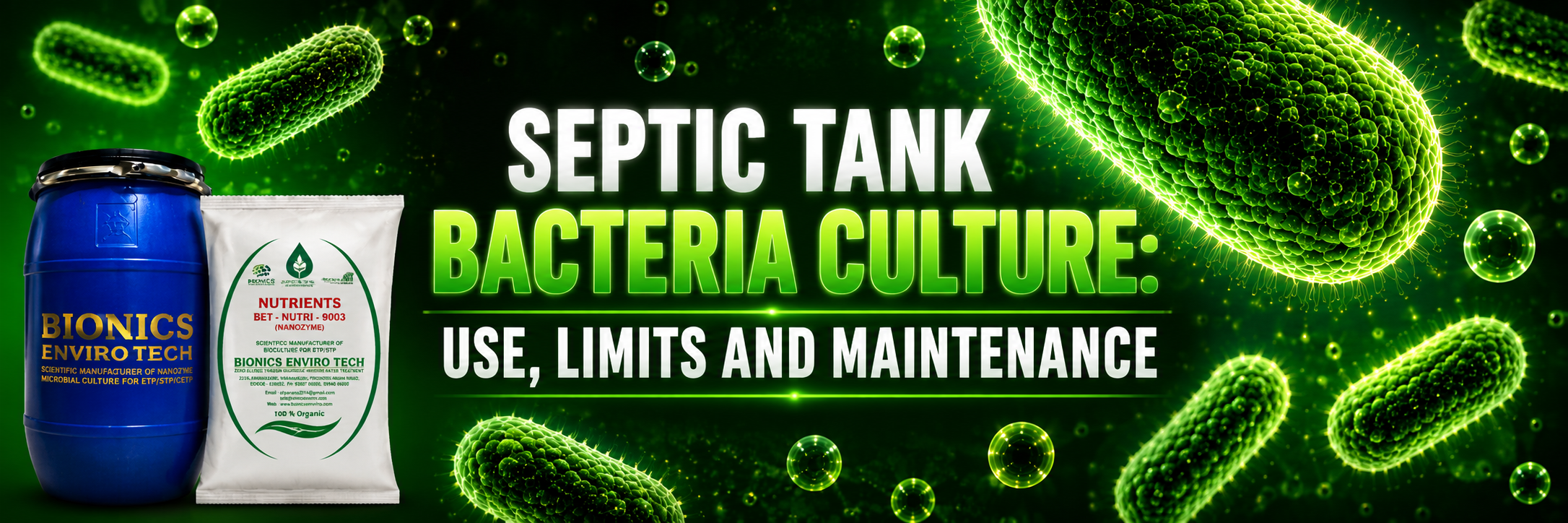
Septic Tank Bacteria Culture: Use, Limits and Maintenance

STP

Septic Tank Bacteria Culture: Use, Limits and Maintenance

Understand how microbial culture may support a functioning septic system and why maintenance, chemical control and desludging still matter.

By Bionics Enviro Tech Team - 1 August 2026 - 6 min read
Sharein

What septic-tank bacteria do

A septic tank relies on microbial activity and physical settling to partially break down biodegradable solids. A compatible supplemental culture may support an assessed system, particularly after conditions that have disturbed the microbial population.

Chemicals can inhibit biology

Large quantities of disinfectant, bleach, acid, alkali, solvent or chemical toilet cleaner can suppress microbial activity. Household and facility teams should prevent inappropriate chemicals from entering the system and follow product safety guidance.

Bioculture is not a substitute for maintenance

No microbial additive removes grit, plastics, non-biodegradable matter or unlimited accumulated sludge. Tanks still require inspection, appropriate desludging and repair when baffles, soakaways or connected systems fail.

Responsible application

Confirm tank condition, occupancy, chemical exposure and maintenance history before application. Use only the approved dose and monitor recurring odour, backup or overflow as a maintenance fault requiring professional inspection.
Frequently asked questions

Can bacteria eliminate septic-tank pumping?

No. Inspection and periodic desludging remain necessary.

What can inhibit septic bacteria?

Excess disinfectants, acids, alkalis, solvents and other toxic chemicals.

Will culture repair a failed septic system?

No. Structural and hydraulic faults require professional repair.

About the author

Bionics Enviro Tech Team

Wastewater Treatment Specialists

The Bionics Enviro Tech team helps operators build resilient, compliant biological treatment systems.

Need help improving your ETP or STP?

Talk to our technical team about a bioculture plan tailored to your influent and operating conditions.

Buy NanozymeContact Us

On this page

  1. What septic-tank bacteria do
  2. Chemicals can inhibit biology
  3. Bioculture is not a substitute for maintenance
  4. Responsible application

Continue learning

Related articles

What Is Bioculture in Wastewater Treatment?

Bioculture

What Is Bioculture in Wastewater Treatment?

Understand what wastewater bioculture contains, what beneficial microorganisms do and which operating conditions determine performance.

7 Aug 20266 min read
Read article
Bioculture for Effluent Treatment Plant (ETP) Operation

ETP

Bioculture for Effluent Treatment Plant (ETP) Operation

A practical guide to selecting, activating and monitoring bioculture in an industrial effluent treatment plant.

6 Aug 20267 min read
Read article
Bioculture for Sewage Treatment Plant (STP) Performance

STP

Bioculture for Sewage Treatment Plant (STP) Performance

Learn how STP microbial cultures support domestic sewage treatment, biomass recovery and odour management.

5 Aug 20266 min read
Read article
Previous

Bioculture for Wastewater Treatment: A Practical Guide to Better Plant Performance

Next

Nanozyme Microbial Culture for Industrial Wastewater Treatment