
Industrial ETP
Nanozyme Bioculture for Industrial ETP Systems
Engineered for robust operation in demanding industrial treatment facilities
Helps ETP operators improve biological performance across changing influent conditions and process loads.
Industry Overview
Industrial ETP
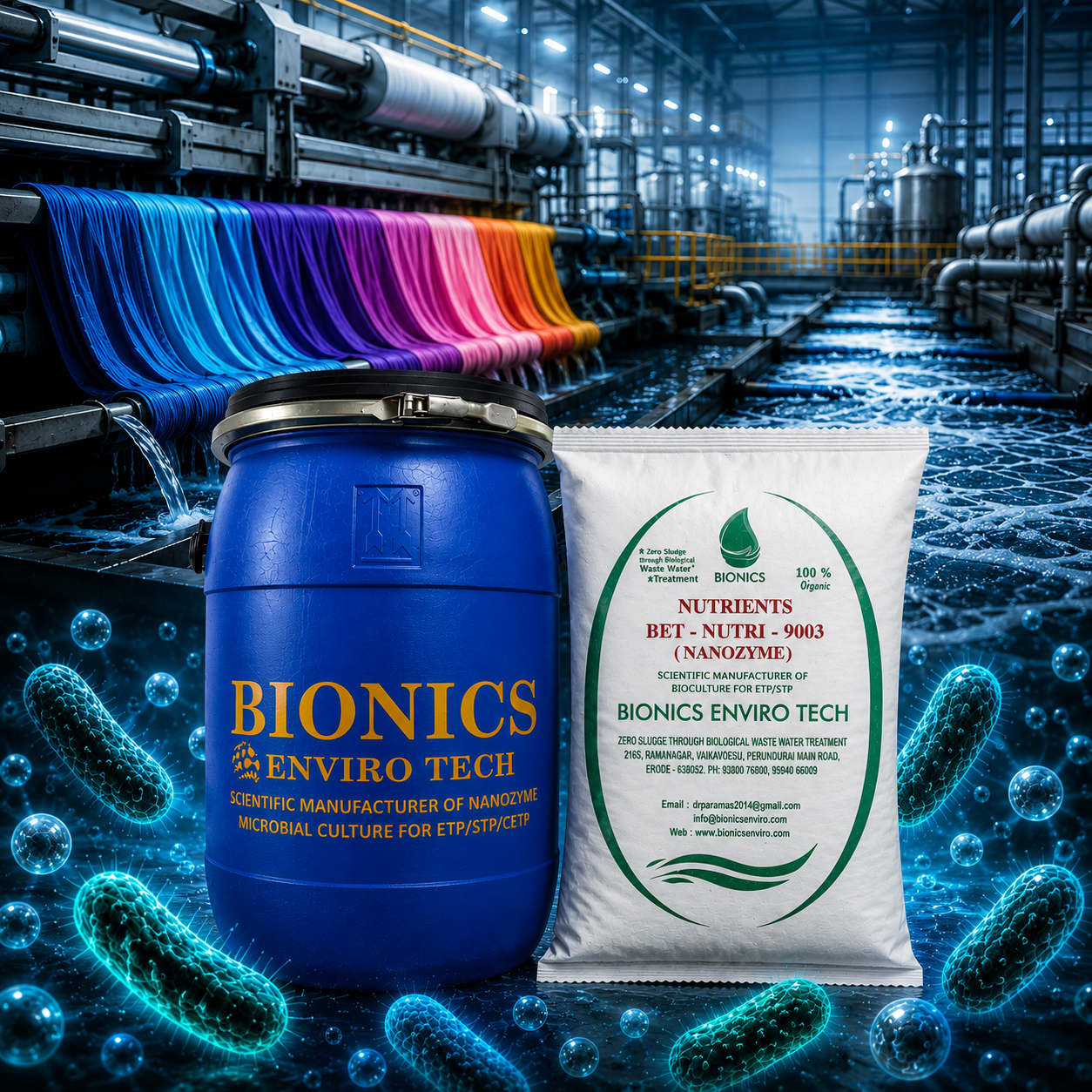
Textile processing operations generate highly variable wastewater with strong colour, elevated organic loading and recurring chemical shocks. These streams often challenge conventional biological systems due to dye residues, surfactants and varying pH conditions.
Bionics Enviro Tech delivers Nanozyme bioculture solutions engineered to stabilize biological treatment in ETPs and CETPs. Our formulations accelerate biodegradation of complex organics while helping operators improve control over COD, BOD and colour.
By strengthening microbial activity, the solution supports faster plant stabilization, lower chemical dependency and improved compliance across dyeing, washing and finishing units.
Wastewater Characteristics
Typical Effluent Profile
Engineered for plants that need to understand influent variability and operating conditions before process optimization.
| Parameter | Typical Range |
|---|---|
| pH | 6.5–9.0 |
| COD | 800–5000 mg/L |
| BOD | 300–2500 mg/L |
| TSS | 200–1800 mg/L |
| TDS | 2000–12000 mg/L |
| Oil & Grease | 20–300 mg/L |
| Colour | High to very high |
| Temperature | 25–45°C |
| Flow Variation | High |
| Shock Load | Frequent |
Major Pollutants
Common Contaminants in Industrial Streams
The biological treatment approach targets the main pollutants that influence process reliability and discharge quality.
Azo Dyes
Complex colouring compounds that are difficult to degrade biologically.
Phenols
Common in process chemicals and require robust biological activity.
Surfactants
Interfere with biological floc formation and aeration efficiency.
Proteins & Carbohydrates
Contribute significant organic load and oxygen demand.
Lignin & Cellulose
Present in fibre processing streams and increase treatment burden.
Heavy Metals
Require careful process control and stable biomass conditions.
Industry Challenges
Operational Constraints That Impact Performance
Traditional systems often struggle under fluctuating water quality, shock loading and inhibitory compounds.
High COD
Organic loading from dyes and auxiliaries can overwhelm conventional systems.
High BOD
Biological oxygen demand rises sharply during washing and dyeing cycles.
Odour
Poorly controlled anaerobic pockets create nuisance odours and process instability.
Colour
Residual colour is often the limiting factor for discharge compliance.
Foaming
Surfactants and process chemicals can cause excessive foam in aeration zones.
Shock Loading
Batch operation and production variability create sudden treatment stress.
Low DO
Overloaded aeration systems limit oxygen transfer and biomass performance.
Microbial Inhibition
Toxic compounds can suppress healthy biomass growth and settleability.
How Nanozyme Works
Biological Treatment Pathway
A structured process designed to convert difficult wastewater streams into stable, treatable effluent.
Raw Wastewater
Complex Organic Matter
Enzymatic Hydrolysis
Biological Oxidation
Microbial Degradation
Stable Biomass
Treated Water
Biological Treatment Mechanism
Stepwise Biological Conversion
Nanozyme supports the biological process from hydrolysis through mineralization.
Hydrolysis
Complex organics are broken down into simpler biodegradable compounds.
Acidogenesis
Intermediate compounds are converted into volatile fatty acids and simpler fragments.
Acetogenesis
The sludge community converts intermediates into substrates that support robust oxidation.
Aerobic Oxidation
Active biomass removes organics and stabilizes the biological process.
Mineralization
The remaining fractions are converted into safer end products and cleaner water.
Scientific Reaction Section
Useful Engineering Reactions
Concise reaction pathways that support practical treatment understanding and plant engineering decisions.
Organic Matter Oxidation
Organic Matter + O₂ → CO₂ + H₂O + Energy
Supports efficient biological oxidation in aeration-based systems.
Ammonium Conversion
NH₄⁺ + 1.5O₂ → NO₂⁻ + H₂O + 2H⁺
Helps maintain nitrogen balance in mixed wastewater streams.
Nitrite Oxidation
NO₂⁻ + 0.5O₂ → NO₃⁻
Supports nitrification and process stability.
Sulphide Oxidation
H₂S + 2O₂ → SO₄²⁻ + 2H⁺
Useful where sulphur compounds create odour and toxicity.
Why Nanozyme
Benefits for Plant Performance
Practical advantages that help operators improve stability, compliance and effluent quality.
Faster Startup
Accelerates microbial establishment in new or stressed treatment systems.
Stable Biomass
Promotes healthier activated sludge and more dependable biological performance.
High Shock Load Resistance
Helps plants recover quickly during rapid process changes.
Lower Chemical Consumption
Reduces reliance on corrective chemical dosing and process intervention.
Less Sludge
Supports efficient conversion and better sludge handling performance.
Odour Removal
Improves process balance and minimizes nuisance release from wastewater systems.
Better Oxygen Utilization
Improves aeration efficiency and biological oxygen uptake.
Eco Friendly
Delivers sustainable treatment support with lower environmental impact.
PCB Compliance
Supports reliable effluent quality and better compliance outcomes.
Product Recommendation
Nanozyme BET-ETP-7003
| Available Form | Liquid microbial culture |
| Bacterial Count | High CFU consortium |
| Shelf Life | 12 months |
| Recommended Dosage | 1–3 L/day depending on plant loading |
| Incubation Method | Pre-activation and controlled dosing |
| Suitable Industries | Textile, dyeing houses, CETP and ETP operators |
| Preferred Application | Aeration tank, equalization tank and polishing unit |
Performance Table
Typical Treatment Improvements
Representative performance outcomes observed in industrial wastewater treatment systems.
| Parameter | Before | After | Reduction % |
|---|---|---|---|
| COD | High | Low | 85–95% |
| BOD | High | Low | 90–98% |
| TSS | Elevated | Controlled | 80–95% |
| Colour | Visible | Reduced | 70–95% |
| Odour | Noticeable | Reduced | 90%+ |
| Sludge | Excessive | Optimized | 30–50% |
| DO | Low | Improved | N/A |
Applications
Where the Solution Is Applied
Frequently Asked Questions
Technical Answers for Plant Operators and Engineers
Clear answers to the most common implementation and performance questions.
Need Technical Assistance?
Our engineers can help optimize your wastewater treatment plant for better performance, lower operating cost and stronger compliance.